

MAGAZINE FALL 2026
Executive Roundtables
Lead Critical Conversations
Pitt Business leaders came together to explore real-world challenges, forge stronger partnerships, and shape a more innovative and impactful future.
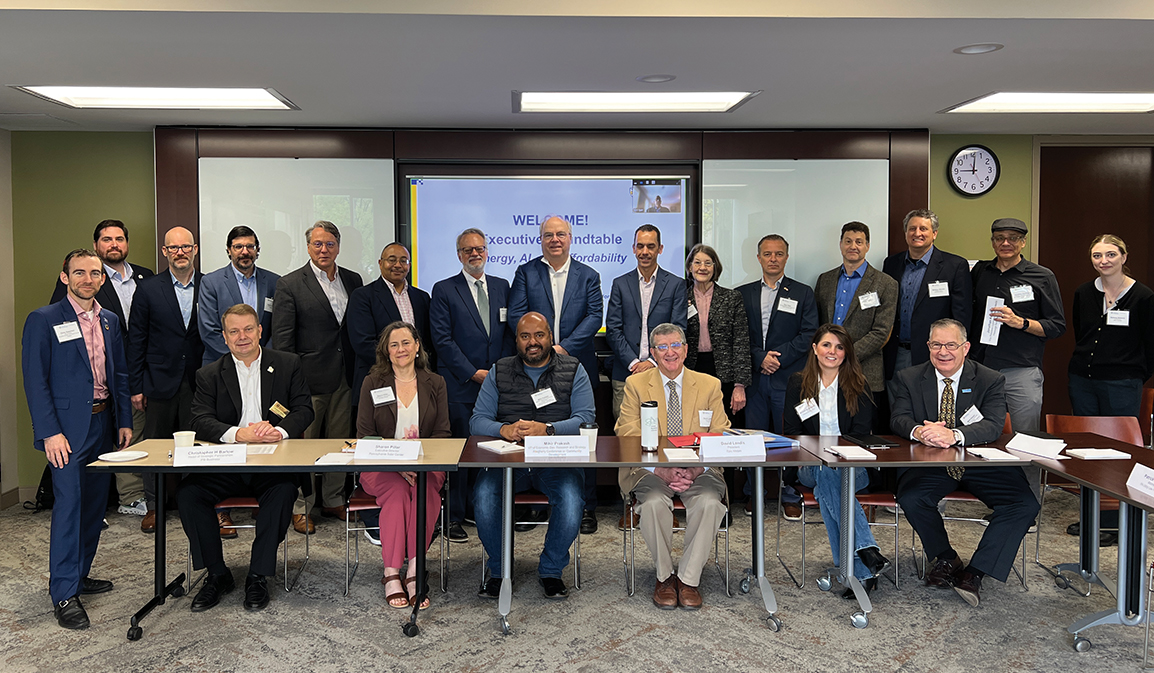
At Pitt Business, we’re committed to transforming academic insight into real-world impact and executive-level collaboration.
Our world-class faculty, forward-thinking programs, and robust corporate partnerships uniquely position the school at the forefront of innovation and leadership development. The invaluable executive insights generated through our ongoing roundtable series further reinforce Pitt Business’s role as an indispensable strategic partner to industry.
We’re not just teaching business, we are driving the collaborative networks, ethical frameworks, and technological advancements that help companies and leaders thrive in a rapidly changing market.
Here’s a quick review of last academic year’s Executive Roundtables.
Energy, AI, and Affordability
On April 15, 2026, utility leaders, corporate executives, policymakers, and consumer advocates came together to discuss the strain of AI-driven data centers on the energy sector.
A major focus was shifting public sentiment, which has moved from NIMBY (“not in my backyard”) to BANANA (“build absolutely nothing anywhere near anyone”) due to concerns over light pollution, noise, and resource consumption.
Participants emphasized that utility management must balance affordability, reliability, and safety equally.
The roundtable highlighted the current market environment as a state of “VUCA”—volatility, uncertainty, complexity, and ambiguity—caused by unpredictable AI energy spikes.
Leaders concluded that navigating this disruption requires public trust, strong governance, and a clear framework for how financial burdens and technological benefits are distributed among communities.
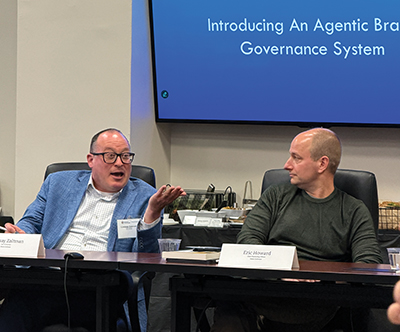
Governance in the Age of AI
On April 6, 2026, academic and cross-industry marketing leaders gathered to address how to capture AI’s potential while minimizing reputational risks.
Associate Dean Vanitha Swaminathan introduced her framework of “agentic branding,” emphasizing that traditional command-and-control brand management is obsolete.
In today’s human-AI ecosystem, brands are continuously shaped by independent algorithms, influencers, and partner networks.
To navigate this lack of direct oversight, Swaminathan outlined six pillars of governance: purpose, systems, personalization, platforms, participation, and partnerships.
Participants discussed using machine learning for “precision marketing,” the operational friction between automated speed and human approval, and the vital need to engage legal teams early.
Ultimately, executives agreed that establishing formal AI governance frameworks is essential to preserving brand integrity.
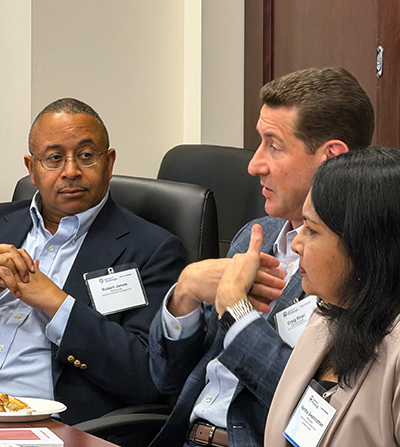
Advancing Belonging Through AI
Bringing together cross-industry leaders, the event on December 11, 2025, explored transforming AI from an organizational disruptor into a tool for fostering deeper human connection.
University leaders emphasized that workplace belonging drives financial performance and overall outcomes.
Rather than replacing workers, participants argued that technology must be “worker-centric,” focusing on human-AI collaboration.
By automating repetitive tasks, AI allows employees to redirect their energy toward high-value, empathetic, and creative responsibilities.
The panel also addressed ongoing challenges, including systemic data biases, regulatory gaps, and an overemphasis on cost-cutting.
To mitigate these risks, leaders stressed the absolute necessity of human oversight.
They concluded that modern workforce performance should shift away from mere execution speed, focusing instead on who can apply the greatest ethical intuition and wisdom to machine outputs.
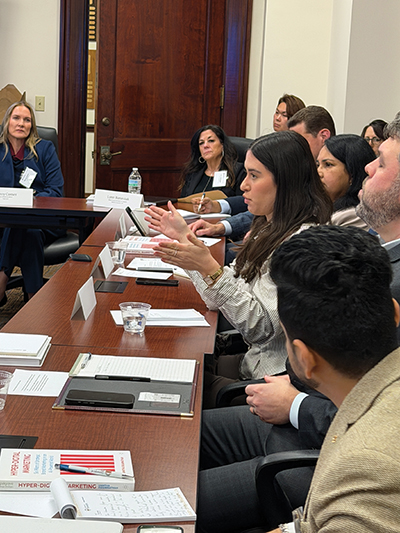
These roundtables bring critical conversations to the forefront—partnerships that drive innovation and leadership that builds stronger futures.
Join the Conversation
If you are interested in learning more about our Roundtable series, contact the Office of Strategic Partnerships at partners@business.pitt.edu .